
Years back, when I was an IT manager, at the end of a long review of projects, I told my team, “Managers like me are always giving you feedback. But I have never asked you for the same. Would any of you like to tell me where I can do better? To be honest, I am looking for areas to improve that are likely my blind spots.” I felt it needless to add that there would be no penalty for being candid. I knew I would probably wince from listening to some feedback but felt confident that I would take it in the spirit of learning and respond professionally. I was not completely surprised that the only reactions I got were silences and smiles. When I repeated my request, I got a few responses on the lines of “All good, Ravi. I have no feedback to give.”
Later that day, Shyam, a Project Manager (not his real name), came to the break-out area to grab a coffee. Seeing there was no one else in the room, I asked him if he really did not have any feedback for me. He said with an apologetic smile, “You could get to know us better. When we go out for drinks and dinner, you could join us. I think you have declined joining us at least three times.” I did not wince but remember thinking of something I had read, “We judge others by their actions and ourselves by our intent.” My team members may have felt I was being aloof and therefore not approachable.
This sort of thing happens in every company every day. Team members avoid opening up in a meeting for several reasons, even if the manager isn’t a tyrant. Here are a few:
- They don’t want to stand out. When the first three people support an idea in a meeting, the fourth person may find it harder to disagree. No one wants to be seen as overly critical or negative. They may think, “everyone seems okay with what’s happening, so maybe I am missing something” or “It’s okay. I’ll just let this one go.” This thought becomes especially strong when the boss visibly rewards the first agreeable answer.
- They don’t know what the manager really wants. A manager may ask, “What do you think?” but team members may have learned in the past that the question actually meant, “Do you agree with what I said?” They have learned to keep their thoughts to themselves.
- They want to protect relationships. Team members sense that speaking honestly has a social cost. This is especially true when a junior employee sees a flaw in what a senior manager has proposed. He/she may think, “If I point this out in front of everyone, I may make my boss look dumb.” The manager leaves the meeting thinking that all is well and the team member leaves knowing that the relationship is intact.
- They don’t want unintended consequences. A workshop participant once said that by speaking up, he got saddled with more work. Team members may think that speaking up can mean an extended discussion, defending their point, being asked to provide evidence, and perhaps creating tension with a colleague.
- They prefer to contribute later. Some of the smartest people I have met were not very quick on their feet but reflected on the problem and gave world-class solutions a little later. Some people do need time and space to think.
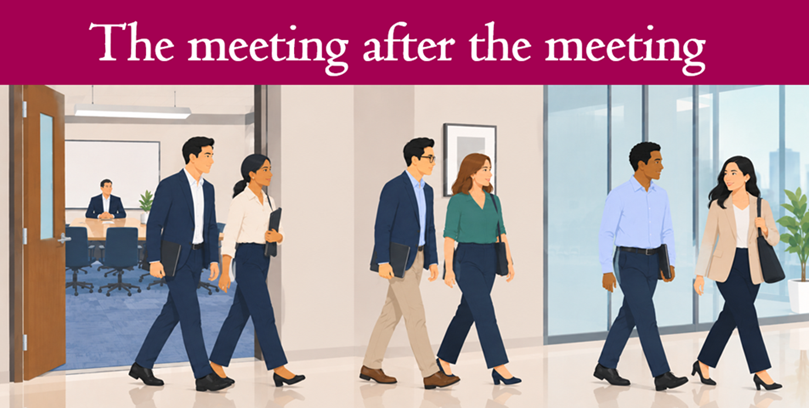
As a leader you will frequently get useful inputs in the meeting after the meeting. The “meeting after the meeting” is not a problem but a symptom. Silence may come from exhaustion, learned caution and seeing that their suggestions went nowhere which can take years to shift. I thought about why it had been hard for Shyam to share his thoughts that morning. He did not open up in the meeting as the feedback was personal, not about a work decision, and so carried a social cost in his mind. I took his feedback seriously, thanked him for his candour and made sure to join team dinners. I learned to do a few things differently from then on:
- I asked for feedback in private
- I made it easier by asking “what are one or two things you would like to see done differently here?”
- I listened when people gave suggestions in meetings
- I acted on them if I could and explained why if I could not
- I shared my ideas towards the end of the discussion – this ensured everyone contributed
- I gave credit when I was able to implement a suggestion I’d received
As a leader, how have you handled this common scenario? What have you done to build trust? I’d love to hear your stories.
The few things you learned to do differently – real gems. Crucial differentiator. Loved it, Ravi.
You hit the nail on the head when you said “The meeting after the meeting is not a problem but a symptom.” Feedback is powerful, but only so if positive candour has the reassurance of fairness in how it is received. Your post has brought that out admirably. Well said, Ravi!
Ravi, you have captured what happens on almost a default basis in most organisations beautifully. Thanks for very cogently peeling the onion to identify the drivers for such behaviour. There is a huge responsibility on the Manager to give comfort to his team that they can share whatever their concerns are and it will be listened to with complete attention – not checking the phone or emails on the side. Most times, it is the way one ‘listens’ (or not) that shuts down the team’s open communication.
Ravi – This is so relevant across every era of the art of leadership and people management. It resonates particularly well with large Delivery functions, where our biggest and most valuable asset is human capital. A great reminder of the importance of investing in, enabling, and leading our people effectively.
There is real insight about human nature here, where you honestly sought feedback but found subordinates had various good reasons not to give it. But learning those reasons opened up your understanding of them & how to supervise them.
This Project Manager, Shyam, did you a real favor by saying what he said. It represented an epiphany for you. We take wisdom in many ways from those around us, so long as we are open to it.