
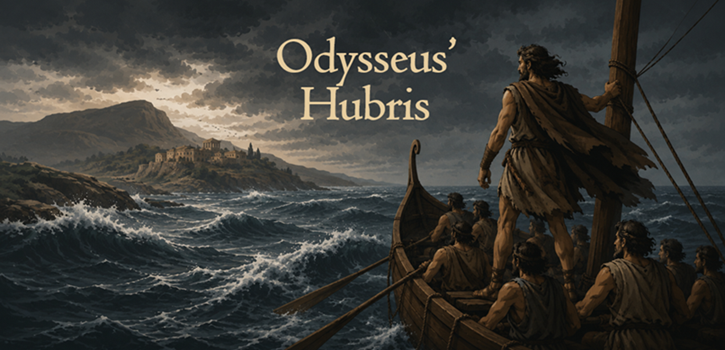
In Homer’s epic poem, The Odyssey, the warrior Odysseus and his men begin their voyage home to Ithaca after destroying the city of Troy. After avoidable delays from a needless battle and lotuses that sap their desire to return home, Odysseus and his men resume their journey home.
Their third stop is the island of the one-eyed giants, the Cyclops. They enter the cave of Polyphemus, the son of the ocean god Poseidon, where they find milk, cheese, and livestock. The giant imprisons them in his cave with a huge boulder and eats them two at a time. Odysseus and his men blind the giant with a burning stake and escape by clinging to the undersides of the giant’s sheep. Polyphemus does not know who these men are, save the word outis (nobody), the clever name Odysseus gave the giant at the beginning.
As they make their escape from the island, the vain Odysseus cannot resist taunting the howling giant and letting him know who was responsible for his pain. Despite his men’s entreaties to stay silent, Odysseus yells from his boat, “Cyclops, if any mortal ever asks who blinded you, tell him it was Odysseus, sacker of cities, son of Laertes, who lives in Ithaca!"
By naming himself, Odysseus gives Polyphemus everything he needs to call down a curse with real teeth. Polyphemus prays to his father Poseidon, asking that Odysseus either never reach home, or reach it late, alone, having lost all his men, and find trouble waiting there too. Poseidon’s curse sticks. From that moment on, Odysseus and men are waylaid time and again by monsters, witch-goddesses, and whirlpools. Odysseus’ hubris ultimately leads to many extra years of wandering and the loss of his entire crew. The word hubris has Greek origins (hýbris) and has come to mean exaggerated pride or arrogance.
While Odysseus displayed cunning, patience and discipline, what undoes him in an instant is his taunt. This cautionary tale tells us that a hubristic leader can:
- Override dissent without interrogating it
- Mistake past success for present infallibility
- Seek credit more than securing outcomes
- Underestimate the competition or the market or the problem
- Believe rules apply to others, not themselves
- Confuse confidence with competence in unfamiliar domains
- Treat others as collateral, not stakeholders
- Refuse to reverse course in the face of failure
Hubris is an all too human trait. Discounting others’ contributions, we may attribute our success to only our own brilliance. It can lead to a failure of imagination and an inability to learn. Others will notice and the hubristic leader will rapidly lose credibility and trust. What makes it particularly dangerous is that it is frequently a blind-spot. Worse, vital feedback may be ignored as it does not fit with the story such leaders tell themselves, a classic case of cognitive dissonance.
So how do I know I may have fallen into the trap of hubris? Here are a few indicators:
- No one pushes back on my ideas in team meetings, consistently
- In an argument, I want to win more than I want to learn
- I feel the need to showboat, even when it can hurt me
- I attribute my successes to the kind of person I am
- I do not keep track of the times I make a mistake
- I rarely ask, “what am I missing?”
- I delay in giving credit to others
- I do not ask for feedback
How do you enhance your self-awareness to catch hubris in your thoughts and actions? What have you done to avoid hubris? I would love to hear from you. And here is a self-assessment I have created you can download.
Brilliantly written Ravi!
At a time when hubris seems to be the norm with leaders of nations and the corporate world, your points on how to identify the symptoms are excellent for those who truly want to get rid of this trait.
For those who don’t want to, God help them and those around them!
Well expressed, Ravi. Hubris is indeed what happens when everything goes well and we start feeling infallible and imagine we are bigger than what we are. Taking a step back, listening, and letting go are underrated traits of a good leader.
Odysseus eventually reaches Ithaca, but his crew paid for his vanity with their lives. In leadership, hubris rarely penalizes the decision-maker first. Instead, it turns colleagues into collateral damage; stifling dissent, burning out talent, and leaving teams to navigate the fallout of unhedged gambles made out of Pride.
Well written Ravi. This message is necessary for today’s leaders to handle unchecked egos and it’s damaging effects.
I really enjoyed this! Your correlative exploration of Odysseus’s hubris against modern leadership values makes for a truly compelling read!
Very well written and thought provoking. “What am I missing?” is perhaps one of the most important questions a leader can ask, especially when success and experience can easily create blind spots.
Thank you, Ravi, for a typically insightful post. It is also especially timely in several ways:
1 – The recent launch of the major motion picture THE ODYSSEY, which presumably will bring at least portions of this ancient myth to new eyes/ears;
2 – And the daily, arrogant display of hubris by a number of world leaders convinced of their own wisdom and invulnerability. In the Odyssey, hubris risked the lives of Odysseus’ men (and himself); now it risks the lives of all of us, as well as helping to impoverish us financially and morally/ethically.
Yes, hubris is a core feature of human nature. But so are its proven antidotes: love, wisdom, knowledge, and concern for those with whom we share the planet (humans & other species).
Insightful concept & guide so well written, connecting to a story