
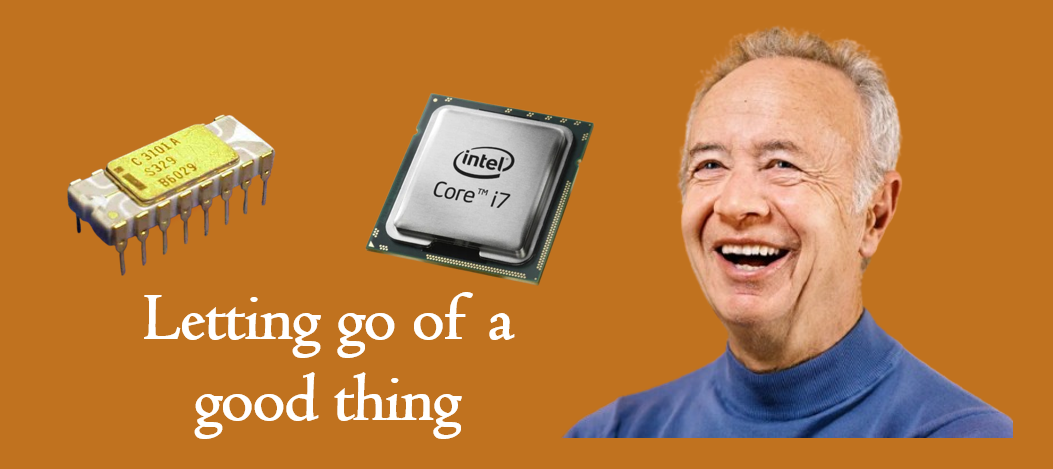
In his fascinating book, ‘Only the Paranoid Survive’, the Hungarian-born co-founder of Intel, Andy Grove writes about when companies face fundamental change in their business. These changes are not limited to technological changes. He called them ‘inflection points’ and wrote that they occur “when the balance of forces shifts from the old structure, from the old ways of doing business and the old ways of competing, to the new.”
Intel faced such a moment in 1985. At that time, the company was the world’s leading manufacturer of memory chips. It was their identity, their origin story, their core business. And memory chips were a genuinely good business, a veritable ‘cash cow’, until Japanese manufacturers began flooding the market with cheaper alternatives, systematically undercutting Intel on price.
Intel’s leaders knew that they faced an inflection point; the time had come to let go of the memory chips business. But they agonized over the decision. They had invested heavily in memory. Their engineers loved the technology. Their salespeople had built strong relationships around it.
It was at this time that Andy Grove had one of the most celebrated moments of clarity in business history. Groves writes, “I was in my office with Intel’s chairman and CEO, Gordon Moore, and we were discussing our quandary. Our mood was downbeat. I looked out the window at the Ferris wheel of the Great America amusement park revolving in the distance, then I turned back to Gordon and I asked, ‘If we got kicked out and the board brought in a new CEO, what do you think he would do?’ Gordon answered without hesitation, ‘He would get us out of memories.’ I stared at him, numb, then said, ‘Why shouldn’t you and I walk out the door, come back and do it ourselves?’”
They did exactly that. And the resources, talent, and focus that were freed up went into developing microprocessors. This became the foundation of one of the most dominant runs in corporate history, the "Intel Inside" era.
Leaders can learn from Grove’s example when to let go of a good thing. Intel recognized that their own idea, however good, was on a downward slope. As leaders, you can ask yourself, when is letting go the right call? The short answer is: when the cost of holding on exceeds the value of the idea itself, in terms of time, capital, relationships, or opportunity cost. The below conditions may be reasons to seriously consider letting go:
- When you're holding on because of an invested ego, not evidence
- When the idea is right but the timing is wrong and you lack the ability to wait
- When execution is draining resources from higher-priority projects
- When the team has lost belief in it, even if you haven't
- When a better version of the idea has emerged and you can't pursue both
Why do we find letting go so hard? While we may recognize these conditions intellectually, the decision to let go gets our emotions involved – it feels like a loss. What has worked until now has history, identity, sunk cost attached to it. It is a story you’ve been telling about yourself. That’s an order of magnitude harder.
This post on Intel’s successful pivot is a companion piece to my post on Kodak’s failure to let go of what worked so well for so long. Do you know of any examples of how companies and individuals saw imminent change, let go of what served them well for years and invested in new things? I would love to hear from you.
Thanks Ravi for story and its Inside
Great insights, Ravi. Thank you.
I like the pun on the word ‘memory’ in “He would get us out of memories”. 🙂
To walk out the door and come back in with fresh perspectives and all prior ‘memory’ and emotions erased isn’t an easy thing to do. Gordon Moore and Andy Grove did it.
The same company, Intel, now finds itself at another inflection point. The company faces intense competition in chip design and manufacturing from rivals such as NVIDIA, AMD, etc. It will be interesting to see how Intel reinvents itself once again.