
In the 1970s, Kodak was close to synonymous with photography. Photos were everywhere, capturing family moments to large functions to vacations in faraway lands. If you held a photo in your hand, it was more than likely made with a camera or film or paper from Kodak. The Rochester, NY, based company was the world’s leading expert on Silver Halide compounds, which were made with Silver and one of the Halogens such as Bromine, Chlorine, Iodine and Fluorine. These compounds are light-sensitive and are commonly used in photographic film and paper. Kodak was proud of its expertise that it had built over decades of research and refinement. Its position looked unassailable (at its peak, it controlled nearly 90% of the global market).
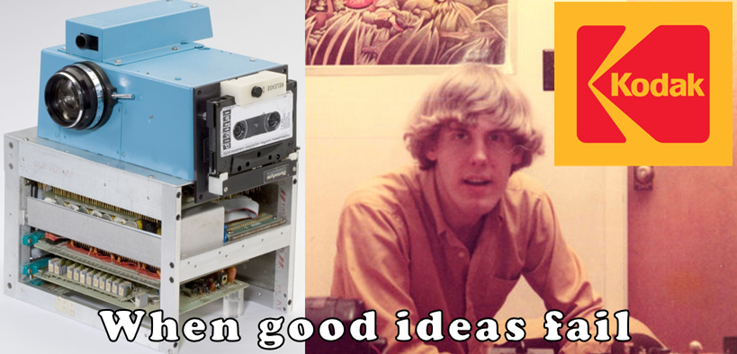
In 1975, one of its young engineers, Steve Sasson (pictured above), developed “a portable, battery-operated self-contained digital camera”. It was crude, used only 10,000 pixels (compare today’s cell phone images with over 10,000,000 pixels), recorded only black-and-white images and took 23 seconds to capture one image. When Sasson presented it internally, the reaction wasn’t of excitement, but of discomfort and skepticism. His leaders saw the technology as interesting but distant, inferior and potentially disruptive to their core film business. He patented the camera in 1978 but was told not to talk about it outside the company.
Sasson continued to work on the camera as a side-project, and in 1989, he and a colleague created the Ecam, the first modern SLR (single lens reflex) with memory cards and a 1.2-megapixel sensor. And yet the company wouldn’t have any of it. Why? Because digital photography threatened Kodak’s core business of film, chemical processing and recurring revenue. In a classic case of cognitive dissonance, the company knew it had something valuable but did not want it to succeed.
Meanwhile, competitors like Canon and Sony, having no such baggage, moved fast, and boldly. By the late 1990s, digital cameras improved rapidly, costs dropped and consumers’ behaviour shifted. Kodak pivoted but too late. They were competing in a space they no longer led, and in 2012, filed for bankruptcy.
What went wrong at Kodak was a failure in leadership, not technology. The company did not miss the future. They saw it but chose to protect the past. They:
- Dismissed the invention out of fear of losing existing business
- Focused on products but not on customer outcomes (capturing and sharing memories)
- Failed to see the potential of the new product and considered it a side-project
- Underestimated how much technology can improve with time
- Suppressed internal discussion of the invention
- Failed to give space and resources to the new technology
- Acted too late
Today’s leaders can learn much from the missteps of Kodak. They can listen carefully to the good ideas their top innovators bring them. They can put some psychological distance between themselves and their ‘cash cows’ and ask, “What could make this obsolete?” They can recognize that even large disruptions start as small blips on the fringe; they rarely arrive fully formed. They can build a culture that does not punish disruption but rewards it. In Sasson’s own words, “it's difficult for companies that have been successful for so long to actually change their approach. That's what you have to do, but it is not that easy.” As we face our own “Kodak moments”, (AI vs traditional workflows, automation vs manual expertise, new revenue models vs legacy revenue, new skills vs old skills), can we see with courage and clarity what we are holding on to because of comfort and stasis and what really needs to be done?
Do you know of any examples of how companies and individuals have pivoted with guts and thoughtfulness? I would love to hear your stories.
Nice blog which is completely relevant to the current trend.
Fantastic article and insightful view of leadership and change. Wow!
You hit the mark, Ravi! Especially about looking beyond the comfort zone of what is to what can be. Great blend of storytelling and teaching!
Darwin Smith’s turnaround of Kimberly Clark is a positive example of leadership that brings together innovation and resilience in the face of disruption.
An excellent case for disruptive innovation. Thanks Ravi
Indeed a very good article.
Interesting blog Ravi. Reminds us that comfort kills innovation faster than competition ever can.
The company that I can recall is Nintendo. Here is the list of Pivots.
1889 – Playing cards
1929 – Toys
1977 – TV and arcade games
1980 – Handheld electronic games
2000 – Mobile games
A fascinating reminder that disruption rarely arrives looking impressive. More often, it arrives looking inconvenient.
The Kodak story is not unique. BlackBerry and Nokia offer equally powerful lessons. BlackBerry dominated the smartphone market with its secure email and physical keyboard experience, yet underestimated how quickly consumer expectations would shift toward touchscreens, apps, and broader digital ecosystems. As former BlackBerry CEO John Chen reflected, “We underestimated the power of the app ecosystem.” What had once been a competitive advantage became a constraint.
Nokia faced a similar challenge. Despite its global leadership in mobile phones, it struggled to adapt to the software-centric future ushered in by smartphones. In his now-famous internal memo, Nokia CEO Stephen Elop wrote, “We are standing on a burning platform,” acknowledging that the company’s success had created a false sense of security while the market changed around it.
What strikes me about the Kodak story is that the challenge wasn’t seeing the future it was letting go of a successful past. As learning leaders, we encounter a milder version of this every day. The practices, programs, and metrics that got us here can quietly become the very things that prevent us from getting where we need to go next.
One observation: organizations often say they want innovation, but what they really want is innovation that doesn’t threaten existing assumptions. That’s a bit like asking for a new route while insisting on staying on the same road.
A contrasting example that comes to mind is Netflix willingly cannibalizing its DVD-by-mail business to embrace streaming. It wasn’t just a technology pivot; it was a willingness to redefine what business they were actually in. Kodak saw itself as a film company. Netflix saw itself as an entertainment company.
At an individual level, I have seen some of the most successful professionals treat expertise as a foundation rather than a fortress. They don’t ask, “How do I protect what I know?” They ask, “What do I need to unlearn?” In the age of AI, that may be one of the most valuable leadership questions of all.
As the saying goes, the enemy of progress is often not ignorance but attachment. Kodak’s camera wasn’t defeated by technical limitations; it was challenged by organizational certainty.
Thank you, Ravi. This is less a story about photography and more a story about courage the courage to disrupt ourselves before someone else does it for us.