
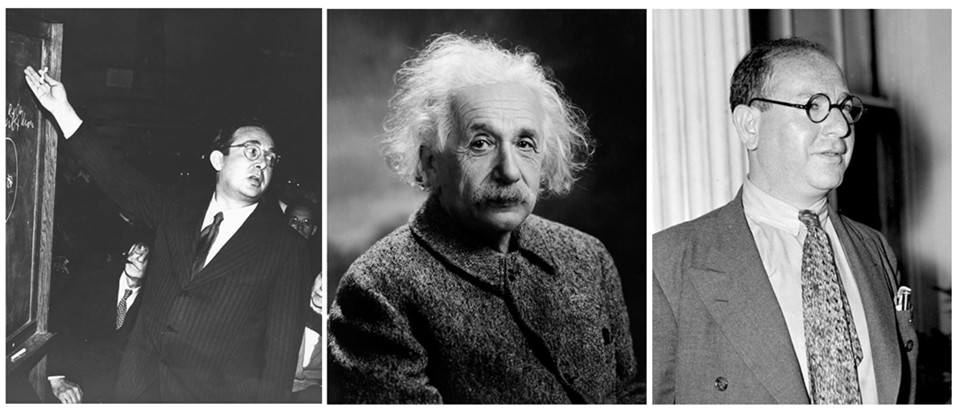
In 1934, seeing the growing menace of the Nazis, the Hungarian-born physicist Leo Szilard moved from Berlin to London. Three years later, he moved to New York to teach at Columbia University. Working with Enrico Fermi, he realized earlier than anyone else that the atom could be split and this fission could lead to a chain reaction, and therefore an unimaginably powerful bomb. What really alarmed him was not just the science but the geopolitics of the time: Nazi Germany had some of the world’s best physicists and more worryingly, had stopped exporting uranium from Czechoslovakia. To Szilard, who knew that uranium was an essential piece of the atomic bomb, this looked ominously like preparation.
Szilard wanted to raise the alarm and persuade the U.S. president Franklin D. Roosevelt to act. Unfortunately, he was neither well-known outside physics nor influential with any politicians. Knowing he was not the right messenger, he enlisted Albert Einstein’s help. He chose Einstein for his global fame, moral authority, and credibility with world leaders. Szilard actually drafted a letter to the president and persuaded Einstein to sign it.
The Einstein-Szilard letter warned the president about Germany’s plans to create the atomic weapon and urged the U.S. to do the same. It explained the new weapon in simple language, avoiding technical jargon and focused on outcomes. The letter framed the situation as a race by pointing out that Germany might already be working on developing this weapon. The letter suggested action, not panic. It recommended government-funded research, securing uranium supplies and establishing a small advisory committee.
Szilard knew that the impact of the letter would be maximum if delivered by someone the president trusted. He enlisted Alexander Sachs, an economist and presidential advisor, to deliver the letter. Sachs waited until Germany invaded Poland in 1939 when the administration’s mindset had moved from ‘war avoidance’ to ‘preparation for the worst’. In a personal briefing to FDR, Sachs recounted how the inventor Robert Fulton offered to build a fleet of steamships for Napoleon Bonaparte so he could invade England without relying on the wind. Napoleon dismissed the idea as fanciful and impractical. Sachs argued that had Napoleon shown more imagination, the history of the 19th century would have been different. He used a vivid metaphor of how a single bomb could destroy an entire harbour and the surrounding city. Sachs chose this particular scenario because he knew harbours were strategic, familiar, and personal to FDR, a former Assistant Secretary of the Navy.
Avoiding sci-fi language, Sachs described a new type of bomb with no precedent, whose power came from within the atom, and was irreversible. Sachs then handed FDR the letter, a validation from the most famous scientist alive. The letter worked as confirmation, not speculation. Without any fanfare or delay, FDR authorized an advisory committee on uranium, funding for research and government oversight. The effort to build an atom bomb, later called the Manhattan Project, was born.
As leaders, we will need to influence decisions, even when we do not have formal authority. We can all learn from this extraordinary example of when Szilard brought the insight, Einstein the authority and Sachs the persuasion acumen. They did not walk into the White House with nuclear equations and try to scare FDR into action. Instead, they acted deliberately to persuade the president to act. They:
- saw second-order consequences early
- enlisted experts to support the message (thus building credibility)
- chose the right spokesperson, a trusted channel
- framed the message for a non-technical decision-maker
- suggested action with calmness, avoiding hyperbole and hysteria
- picked the right time to deliver the message
- highlighted timing and competition (thus giving a sense of urgency)
- used historical analogy to create weight and provide parallels
- used visual metaphors to make scale tangible
- let the decision-maker feel they reached the conclusion themselves
Important ideas often fail not because they are wrong, but because they are poorly framed or arrive without the right messenger. Persuasion, at its best, is an act of responsibility, helping others see what is coming, why it matters, and what must be done. The next time we need to persuade someone, can we remember that we don’t have to be the loudest voice in the room? We only need the clarity to see the issue, the humility to enlist others, and the courage to speak when it matters most.
How have you persuaded others? Do you have any examples to share in the comments section below? I would love to hear from you.
Nice article Ravi. This is very relevant for current times and an important reminder of how critical this quality is.
Excellent insight, brought out through History
Ravi: I can think of no better illustration of persusasion than your compelling example. I’m a U.S. citizen, so this is compelling for 2 other reasons:
1 – It shows the contributions of German Jews (Szilard & Einstein) who abandoned Nazi Germany and brought their considerable intellectual abilities to the U.S., aided greatly by an American banker who also was Jewish (Sachs)
2 – Their collaboration demonstrates the power of emigration & the contributions of immigrants to their new home
This is made even more compelling by the rapid growth (more accurately, re-growth) of anti-semitism and anti-immigrant sentiments in the U.S. at this time.
Features tell, Benefits sell. Selling to C suites need to be without jargon and Science. Simple analogies are what makes them decide. You have amplified that concept with the right story. Great writing . Always original.
Simply superb, Ravi. The story. The story telling style to ‘persuade’ the leader to imbibe this strategy. And a summary of what is required of leaders to deliver mutually beneficial outcomes.
Superbly articulated , Ravi. And written in an extremely persuasive manner, just like you advocated for persuasion.
What hits the nail on the head is what you said about persuasion being an act of responsibility. When the purpose starts with that mindset, half the battle is won!
As always, you bring forth great thoughts with engaging simplicity.
Fantastic blog Ravi, the example is superb. I acknowledge your conclusions very much specially for difficult and long lasting decisions.
Ravi – This is awesome. You brought in a good analogy from history to explain well. This historical is a great learning for me personally – but a more important message is to apply the principle in our workplace.
I am impressed as always with your ability to communicate.
Ravi, this is a truly powerful and thought-provoking post. You have taken a pivotal moment in history and distilled it into timeless leadership lessons on influence, timing, and responsible persuasion. The way you highlighted the interplay between Szilard’s insight, Einstein’s authority, and Sachs’ storytelling acumen beautifully illustrates that influence is rarely about volume, it is about strategy.
Your line about ideas failing due to poor framing really stands out. A strong reminder that how we communicate matters as much as what we communicate.
Thank you for sharing such a rich and relevant lesson.
Very well explained ! Loved the example to explain the concept ! Agree with you that ideas fail due to improper framing or not enough efforts in conveying it ! Keep writing !